
Defining AI.
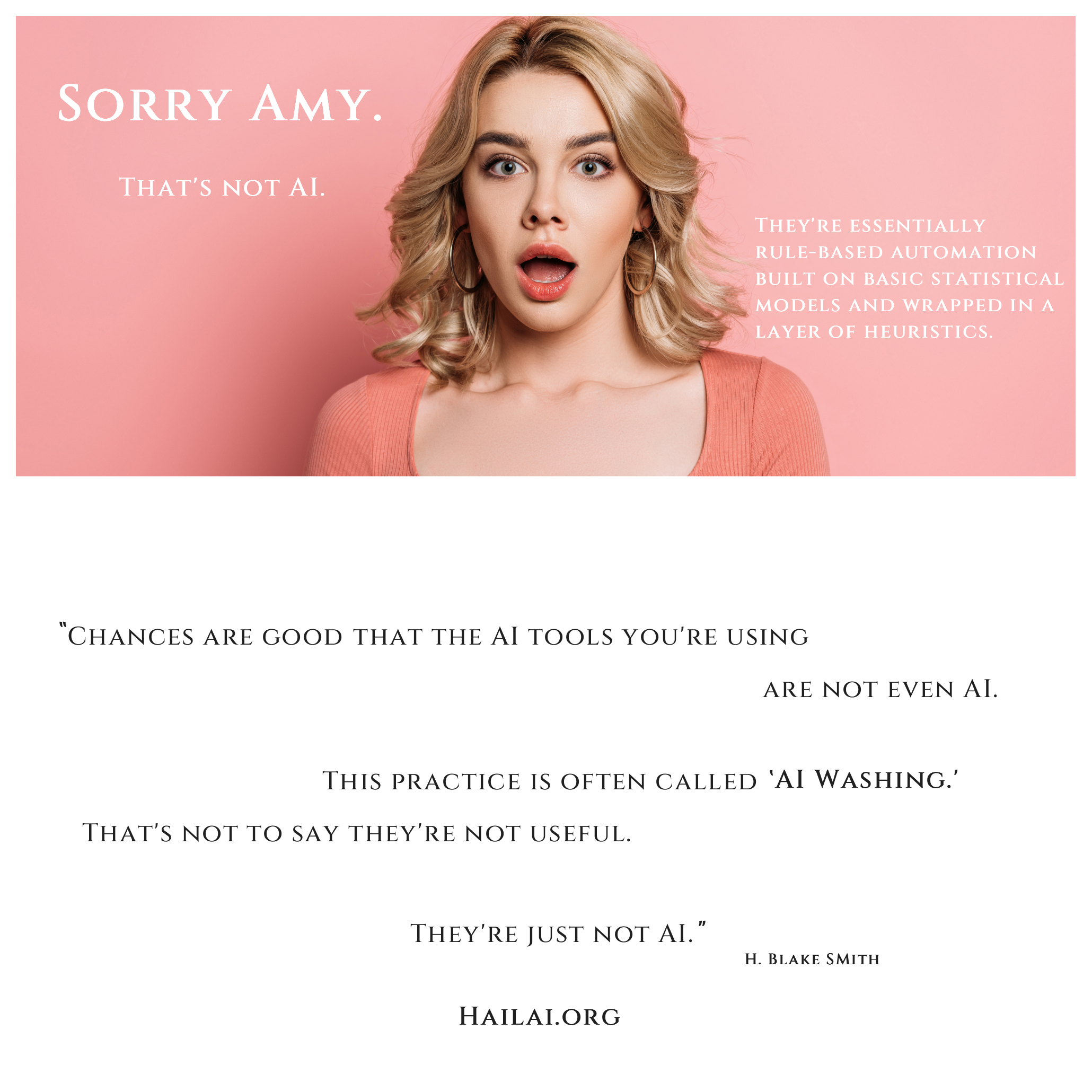
A great deal of software marketed today as “AI” for websites and backend applications is not actually artificial intelligence in the modern sense. That does not mean these tools lack value—many are useful and well-engineered—but the terminology has often outpaced the underlying technology. In many cases, the “AI” label is applied to systems that rely on traditional automation techniques rather than machine learning or language models capable of interpreting and generating knowledge dynamically.
Many of these products operate using conventional software approaches such as predefined workflows, deterministic rules, or decision trees. Others use basic statistical models that have existed for decades and do not adapt meaningfully over time. Still others rely on heuristic scoring systems—essentially weighted logic designed by humans to approximate decision-making. These techniques can be effective for certain tasks, but they do not represent the type of learning, reasoning, and generative capability associated with modern AI systems.
Common examples of what is often marketed as AI include:
Rule-based automation that executes predefined actions when certain conditions are met
Traditional statistical models that analyze historical data without dynamic learning
Heuristic scoring systems that approximate decision logic through weighted rules
Workflow automation engines that trigger actions based on scripted inputs
This phenomenon has become widely known as “AI washing,” the practice of rebranding existing software or automation tools as artificial intelligence in order to ride the current technology hype cycle. The result is understandable confusion: users are told they are buying AI when, in reality, they are purchasing sophisticated—but fundamentally conventional—software systems.
Authentic AI systems differ in an important way. Modern AI typically involves machine learning models that can interpret natural language, synthesize information from multiple sources, generate novel outputs, and adapt based on data. These systems are probabilistic rather than deterministic, meaning they do not simply follow scripted rules but instead analyze context and produce responses dynamically.
This is where architectures such as HAIL differ from many traditional “AI-labeled” tools. Rather than relying on static rule sets or heuristic automation, HAIL operates as an AI orchestration system designed to coordinate real language models. It works by engaging multiple AI engines, reconciling their outputs, and structuring the resulting intelligence into organized, publishable content. In other words, it does not attempt to simulate AI with scripts; it manages and synthesizes the capabilities of genuine AI systems.
At its core, HAIL reflects a growing shift in how production AI systems are built. Instead of a single model performing every task, modern architectures often involve multiple AI components working together, combining generation, validation, and formatting layers into a coordinated workflow. By orchestrating these systems rather than replacing them with rules or heuristics, HAIL aligns with the direction real AI development is taking.
In a landscape increasingly crowded with marketing claims, authenticity matters. Recognizing the difference between traditional automation and genuine AI is important for both developers and users. Useful tools should be valued for what they are—but when a system truly leverages modern artificial intelligence, it should be clear in how it operates. HAIL’s architecture reflects that distinction: not a rebranding of automation, but a framework designed to organize and deploy real AI capabilities in a structured and practical way.