
HAIL AI™ as a Function
Explaining the System
“Below is the formal HAIL AI functional expression that governs system control flow and AI execution sequencing.”
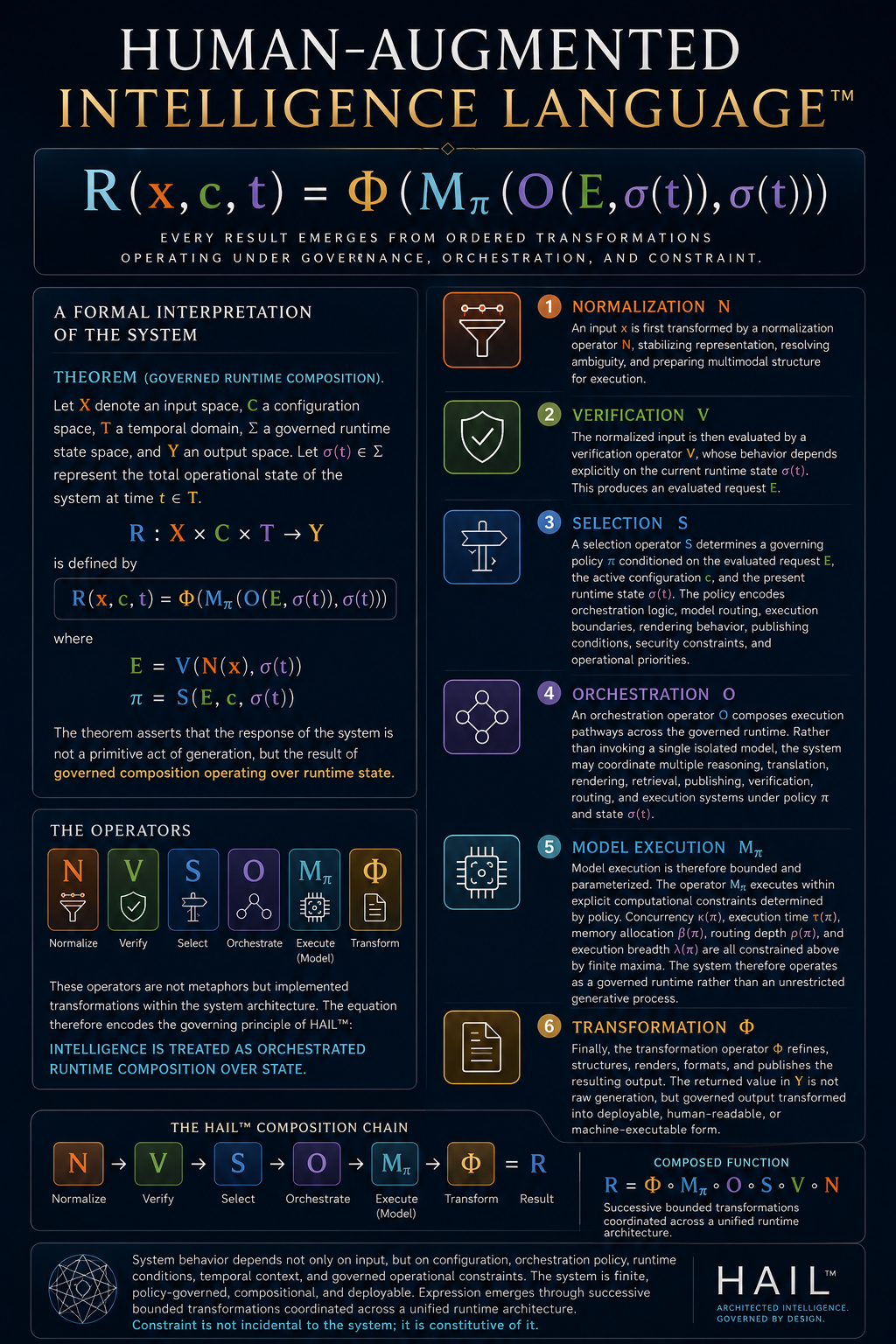
A Formal Interpretation of the System
Theorem (Governed Runtime Composition).
Let X denote an input space, C a configuration space, T a temporal domain, Σ a governed runtime state space, and Y an output space. Let σ(t) ∈ Σ represent the total operational state of the system at time t ∈ T.
R : X × C × T → Y
is defined by
R(x,c,t) = Φ(Mπ(O(E, σ(t)), σ(t)))
where
E = V(N(x), σ(t))
π = S(E, c, σ(t))
The theorem asserts that the response of the system is not a primitive act of generation, but the result of governed composition operating over runtime state.
An input x is first transformed by a normalization operator N, stabilizing representation, resolving ambiguity, and preparing multimodal structure for execution. The normalized input is then evaluated by a verification operator V, whose behavior depends explicitly on the current runtime state σ(t). This produces an evaluated request E.
A selection operator S determines a governing policy π conditioned on the evaluated request, the active configuration c, and the present runtime state. The policy encodes orchestration logic, model routing, execution boundaries, rendering behavior, publishing conditions, security constraints, and operational priorities.
An orchestration operator O composes execution pathways across the governed runtime. Rather than invoking a single isolated model, the system may coordinate multiple reasoning, translation, rendering, retrieval, publishing, verification, routing, and execution systems under policy π and state σ(t).
Model execution is therefore bounded and parameterized. The operator Mπ executes within explicit computational constraints determined by policy. Concurrency κ(π), execution time τ(π), memory allocation β(π), routing depth ρ(π), and execution breadth λ(π) are all constrained above by finite maxima. The system therefore operates as a governed runtime rather than an unrestricted generative process.
Finally, the transformation operator Φ refines, structures, renders, formats, and publishes the resulting output. The returned value in Y is not raw generation, but governed output transformed into deployable, human-readable, or machine-executable form.
The operators N, V, S, O, Mπ, and Φ are not metaphors but implemented transformations within the system architecture. The equation therefore encodes the governing principle of HAIL™: intelligence is treated as orchestrated runtime composition over state.
System behavior depends not only on input, but on configuration, orchestration policy, runtime conditions, temporal context, and governed operational constraints. The system is finite, policy-governed, compositional, and deployable. Expression emerges through successive bounded transformations coordinated across a unified runtime architecture. Constraint is not incidental to the system; it is constitutive of it.
R=Φ∘Mπ∘O∘S∘V∘N
In Regular Speak…
At its core, the equation says this: the result you receive is not produced by a single model acting alone. Your input is first normalized, interpreted, and evaluated within the current runtime state of the system. HAIL™ then determines how the request should be orchestrated — including which reasoning systems, rendering pathways, execution layers, verification steps, or intelligence services should participate in producing the final result.
Rather than executing a single isolated inference step, the system composes coordinated operations across a governed runtime architecture. Routing, orchestration policy, execution boundaries, rendering behavior, publishing logic, and system state all influence how the response is constructed.
Every operation executes within explicit constraints governing time, concurrency, resource allocation, routing depth, and policy enforcement. The resulting output is then refined, structured, rendered, and transformed into deployable or human-readable form before being returned.
In simpler terms, HAIL™ does not “just generate text.” It operates as a governed intelligence runtime. The system prepares requests, evaluates context, orchestrates multiple capabilities, executes bounded operations across coordinated systems, and transforms the results into usable output. The equation expresses that disciplined runtime composition in compact form: every result emerges from ordered transformations operating under governance, orchestration, and constraint.

Quantica™ is a precision-driven mathematical engine built for real estate, mortgage structuring, financial modeling, and advanced quantitative analysis. It transforms complex inputs—loan terms, amortization schedules, cash-flow scenarios, rate sensitivities, portfolio structures—into exact formulas, structured outputs, and defensible numeric results in seconds. Whether calculating principal and interest, modeling IRR and NPV, stress-testing rate changes, optimizing payment structures, or formalizing abstract financial systems, Quantica™ delivers deterministic, equation-first clarity with no guesswork and no fluff. It is engineered for professionals who require rigorous computation, transparent assumptions, and mathematically sound conclusions across property finance, lending, investment analysis, and beyond.